CBSE Class 10 AI project (subject 417): a step-by-step guide
The project carries 10 marks, plus 5 for its viva. Here is how to choose an idea, plan it with the AI Project Cycle and present it, using free apps that run in the school lab or on a phone.
Short answer
In the CBSE Class 10 AI (417) syllabus for 2026-27, practical work is worth 50 marks: practical file 15, practical exam 15, viva 5, project (or field visit or portfolio) 10, and project viva 5. Pick a real problem linked to a Sustainable Development Goal, plan it stage by stage in AI Project Cycle Canvas, build a small model, and explain how you tested it.
Plan your AI project in 6 steps
-
Pick a real problem and an SDG
Choose a problem you can see around you: food waste in the canteen, potholes, water shortage, crop disease or exam stress. Link it to one of the 17 Sustainable Development Goals, as CBSE asks.
-
Scope the problem with the 4Ws
Open AI Project Cycle Canvas and start a new project, or open a sample first. Answer Who has the problem, What it is, Where it happens and Why it matters, then write your problem statement.
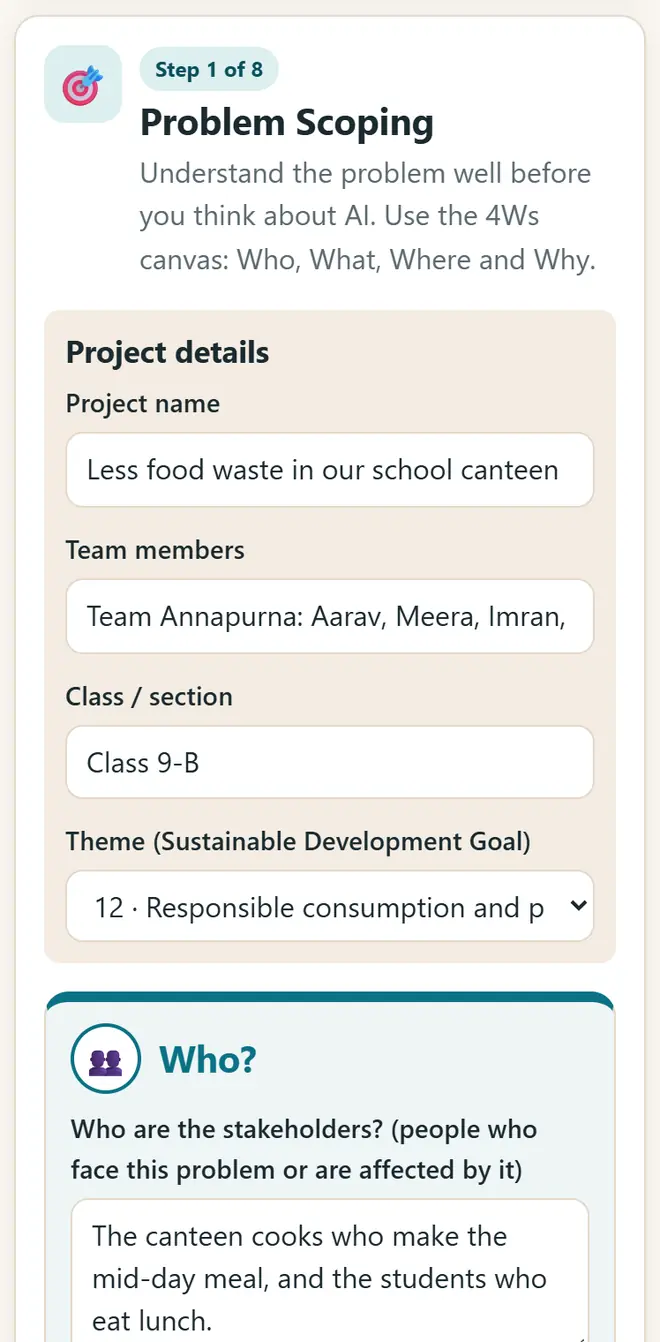
AI Project Cycle Canvas: the 4Ws of a sample project. -
Plan the data
Write down which data you need, where it will come from (a survey, photos, a sensor or a public dataset) and how you will keep it private. In Data Exploration, draw a simple chart of it.
-
Build a small model
Choose the AI domain: Statistical Data (tables), Computer Vision (images) or NLP (text). Try it with free apps: Teach the Computer (Image AI) for photos, Train a Mood Detector for text or Python Playground for code. CBSE's own sample projects are penguin species prediction, early detection of coral bleaching and sentiment analysis.
-
Evaluate it honestly
Test the model on data it has not seen. Fill in a confusion matrix and see accuracy, precision, recall and F1 in Is My AI Good? (Evaluation). Write down where the model goes wrong and why.
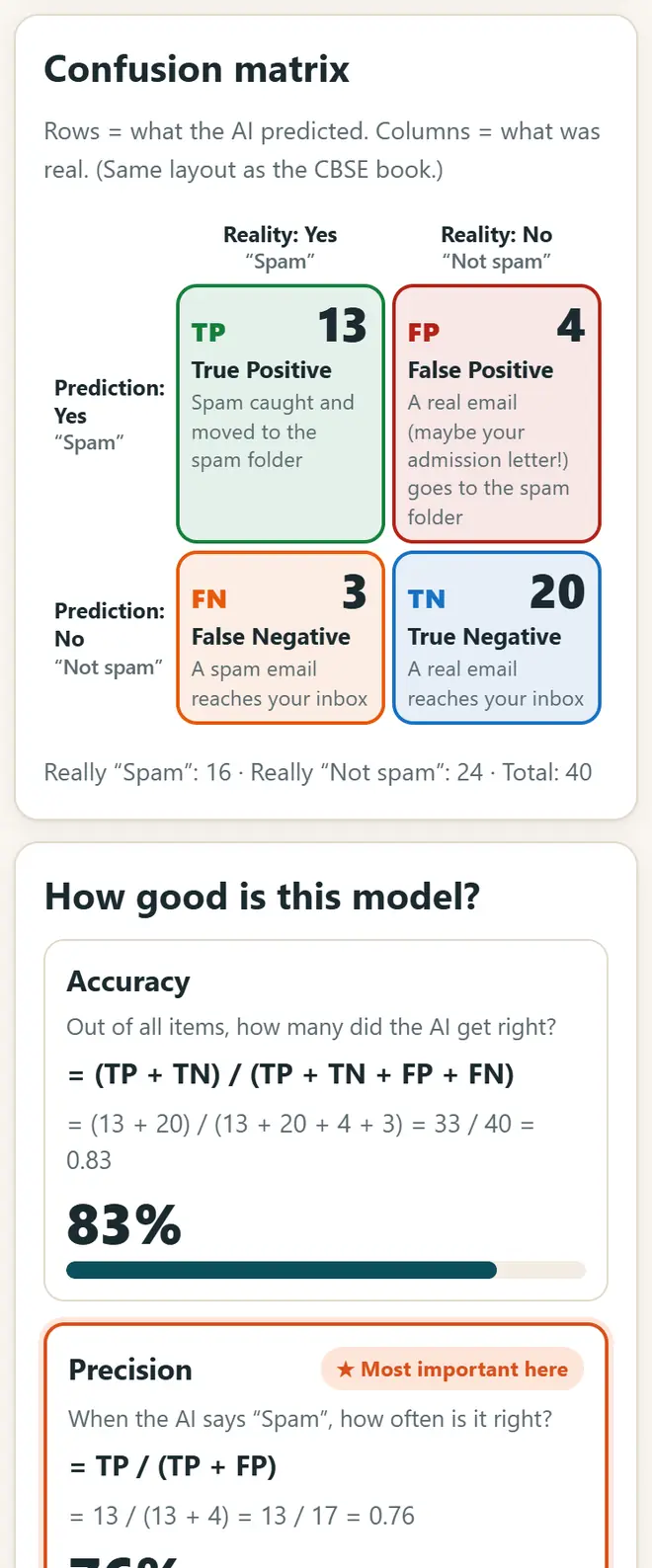
Model evaluation: confusion matrix, accuracy, precision and recall. -
Check the ethics and print the canvas
Answer the ethics questions on privacy, fairness and safety, then open the full canvas and print it for your project file. Practise a two-minute explanation for the viva.
Class 10 AI project ideas with an SDG
- Statistical Data: predict which students may need extra help from made-up attendance and test scores (SDG 4, Quality Education).
- Computer Vision: sort photos of waste into wet and dry (SDG 12, Responsible Consumption and Production).
- Computer Vision: spot leaf disease in photos of crops (SDG 2, Zero Hunger).
- NLP: find happy, sad or angry comments in feedback forms (SDG 3, Good Health and Well-being).
- NLP: a school help chatbot that answers questions about timings and events (SDG 4, Quality Education).
Get new free tools and Hindi AI lessons
Join our email list to hear about new free apps, new guides and Hindi video lessons on AI. No spam.
For adults (18+). You can unsubscribe at any time.
Why we recommend these tools
- Free for everyone: no ads, no sign-up and no paid plan.
- Private: your files and details stay on your own device.
- Works on a phone, laptop or smartboard, and offline once opened.
- Available in 12 languages, including Hindi.
Prefer video? Watch free Hindi lessons on AI and free tools on our YouTube channel.
Frequently asked questions
How many marks is the Class 10 AI project?
In the 2026-27 syllabus, Project Work / Field Visit / Student Portfolio (any one) carries 10 marks and its viva 5 marks, out of the 50 practical marks. Always check the latest syllabus on cbseacademic.nic.in.
What should the project file contain?
A good project file usually has the title and SDG, the 4Ws problem canvas, the data sources, a chart of the data, the model you built, how you tested it (accuracy or a confusion matrix), an ethics check and what you would improve.
Do I need coding for the project?
Not always. Unit 4 uses no-code tools such as Orange, and photo or text models can be trained without code. Python helps for the practical file, which needs at least 15 programs.
Is the practical file the same as the project?
No. The practical file (15 marks) has at least 15 programs, such as adding lists, mean, median and mode with NumPy, charts and reading a CSV file or an image. The project (10 marks) solves one real problem.
Is this an official CBSE resource?
No. It is an independent, free guide based on the CBSE curriculum for 2026-27. Your teacher and the official syllabus have the final word.
Found this useful?
Send it to a friend, your colleagues or your school's WhatsApp group.