In-hand salary from CTC: calculate it for Tax Year 2026-27
Your CTC is not what reaches your bank. PF, professional tax, gratuity and income tax come out first. Here is how to work out your real monthly in-hand pay, and which tax regime is better for you.
Short answer
Monthly in-hand pay = (CTC − employer PF − gratuity − yearly bonus) ÷ 12, minus your own PF, professional tax and monthly income tax (TDS). For Tax Year 2026-27, the new regime has no tax on income up to ₹12 lakh, which is a salary of ₹12.75 lakh after the ₹75,000 standard deduction. Salary & Income Tax Calculator does all of this for you.
Find your in-hand salary in 5 steps
-
Type your yearly CTC
Open Salary & Income Tax Calculator and type your CTC the way you say it: 12L, 12.5 lakh, 85k or 12,00,000. The monthly in-hand pay appears at once.
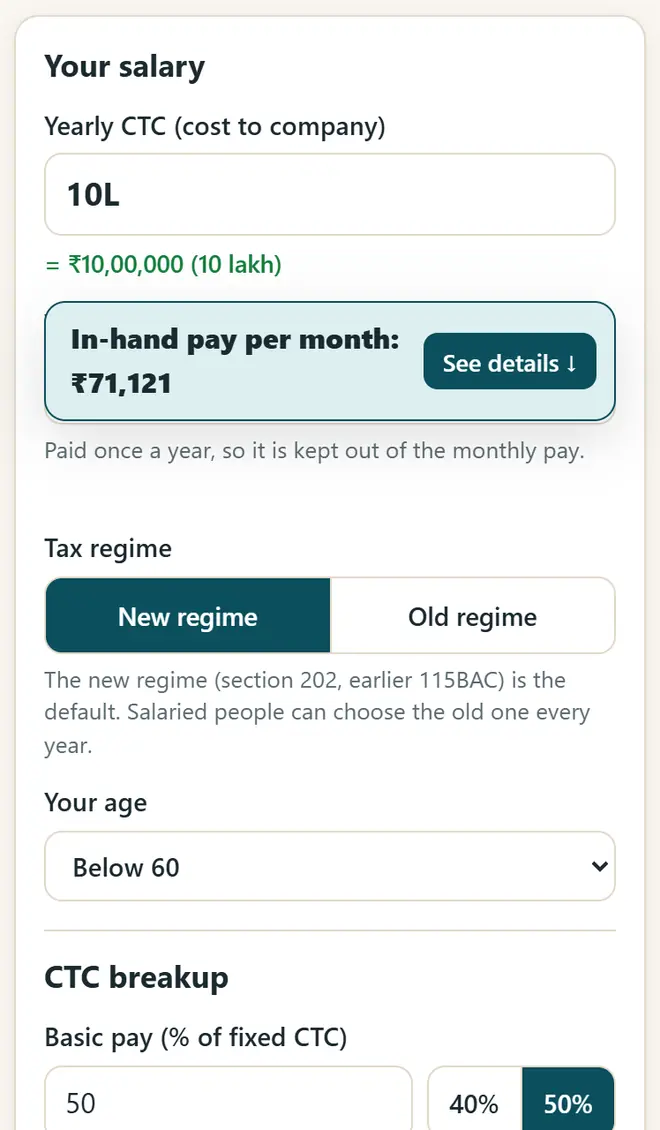
Type the CTC: the monthly in-hand pay appears at once. -
Copy the CTC breakup from your offer letter
Fill in the basic pay %, HRA, PF, gratuity and bonus from your offer letter, and choose your state for professional tax. The result then matches your payslip closely.
-
Compare the new and old regimes
Open “Old vs new regime”. Fill in your rent, 80C, 80D and home-loan interest under the old-regime deductions. The app shows which regime saves more, and the break-even amount.
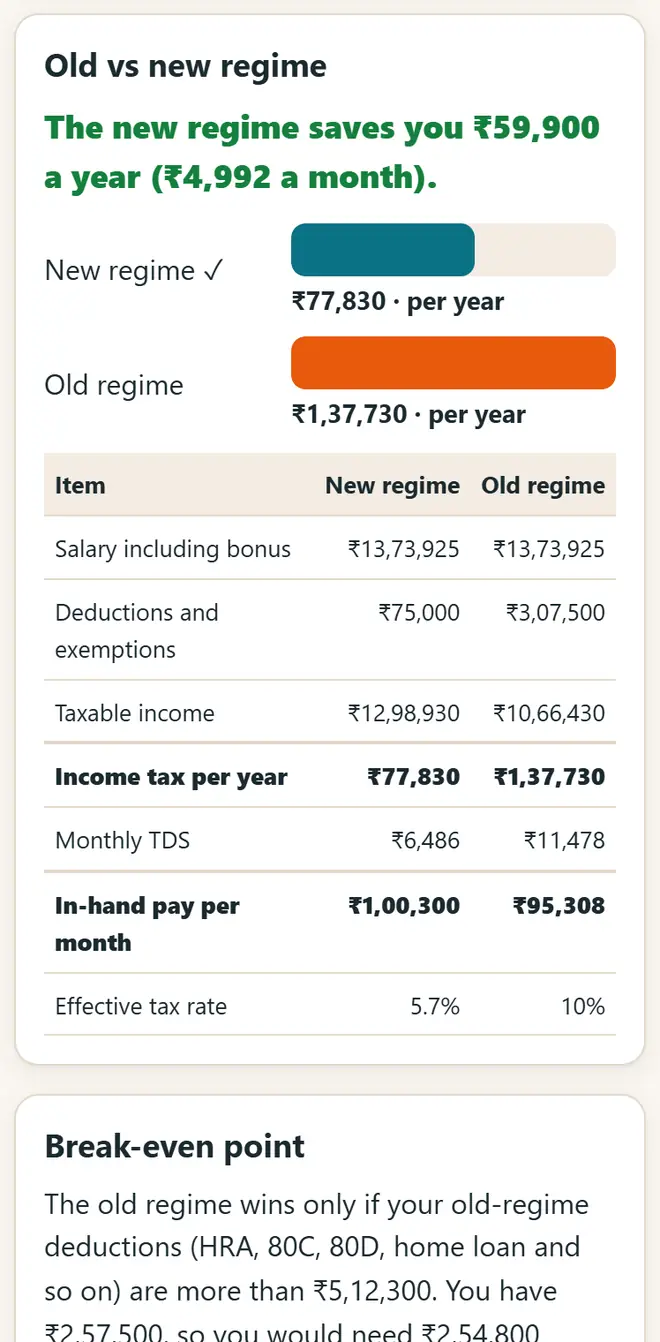
Old vs new regime, with the break-even point. -
See how the tax is worked out
Open the tax working to see the standard deduction, the tax for each slab, the rebate, the cess and the monthly TDS, line by line.
-
Check a hike or a job offer
Use “Salary hike” to see how much of a raise reaches your bank, and “In-hand → CTC” to find the CTC to ask for in a new job.
New tax regime slabs for Tax Year 2026-27
- Up to ₹4 lakh: nil · ₹4–8 lakh: 5% · ₹8–12 lakh: 10% · ₹12–16 lakh: 15% · ₹16–20 lakh: 20% · ₹20–24 lakh: 25% · above ₹24 lakh: 30%.
- Standard deduction for salaried people: ₹75,000 in the new regime and ₹50,000 in the old regime.
- Rebate: no tax if the total income is up to ₹12 lakh in the new regime (₹5 lakh in the old regime), with marginal relief just above ₹12 lakh.
- A 4% health and education cess is added to the tax. These rules come from the Income-tax Act, 2025, in force from 1 April 2026; Budget 2026 did not change the slabs.
This guide is general information, not tax or legal advice. Check your own case with a tax professional.
Get new free tools and Hindi AI lessons
Join our email list to hear about new free apps, new guides and Hindi video lessons on AI. No spam.
For adults (18+). You can unsubscribe at any time.
Why we recommend these tools
- Free for everyone: no ads, no sign-up and no paid plan.
- Private: your files and details stay on your own device.
- Works on a phone, laptop or smartboard, and offline once opened.
- Available in 12 languages, including Hindi.
Prefer video? Watch free Hindi lessons on AI and free tools on our YouTube channel.
Frequently asked questions
What is the in-hand salary for a CTC of ₹10 lakh?
With a common breakup (basic 50% of CTC, PF on the full basic, gratuity inside the CTC, ₹2,500 professional tax), ₹10 lakh CTC gives about ₹71,000 a month in the new regime, with zero income tax. Your own figure depends on your breakup.
Is income up to ₹12 lakh tax-free in 2026-27?
In the new regime, yes: the rebate makes the tax zero when the total income is up to ₹12 lakh. For salaried people, that means a salary of up to ₹12.75 lakh after the ₹75,000 standard deduction.
Which is better, the new or the old regime?
For most people without big deductions, the new regime gives less tax. The old regime can win if you claim large HRA, 80C, 80D and home-loan deductions. The calculator shows the break-even point for your salary.
What is the difference between CTC and gross salary?
CTC is everything the company spends on you in a year, including the employer's PF and gratuity. Gross salary is CTC minus those. In-hand pay is the gross minus your own PF, professional tax and income tax.
Is my salary information stored anywhere?
No. The calculator runs on your device. Nothing is uploaded, and there is no login.
Found this useful?
Send it to a friend, your colleagues or your school's WhatsApp group.